
Executive Summary
Living in a 2005 Jeep Liberty on little to no money in Iowa presents significant challenges—but it is achievable with careful planning, legal awareness, and resourcefulness. This guide synthesizes evidence from legal experts, car-dwelling communities, Iowa assistance programs, and survival specialists to provide a comprehensive roadmap. The key findings: Iowa rest areas offer the safest legal sleeping options, a DIY wooden platform solves the Jeep's awkward folding seats for under $20, Iowa's extreme winters require layered insulation without engine idling, and free Wi-Fi networks combined with state assistance programs can sustain you while you stabilize your situation. Relocation within rural Iowa or to neighboring states can further reduce legal risks. This report provides actionable strategies for every aspect of car living—from avoiding OWI charges to staying cool in 90°F humidity—all tailored to the specific constraints of a 2005 Jeep Liberty and an Iowa location.
1. Legal Landscape: Where You Can (and Cannot) Sleep in Iowa

The Rest Area Advantage
Iowa's legal framework for sleeping in vehicles is more nuanced than many car-dwellers assume. The most critical finding is that sleeping in your car is generally legal statewide, but location-specific restrictions create a minefield if you're not informed. Iowa DOT rest areas are your best friend here—they allow stays up to 24 hours, with possible extensions for weather or mechanical issues source. This is consistent with findings from multiple sources, which agree that rest stops are the safest legal option.
What makes rest areas particularly valuable is the infrastructure: many have bathrooms, vending machines, and even free Wi-Fi. For someone with little to no money, this means you can address hygiene, hydration, and connectivity in one stop. The rule against camping gear outside the vehicle is strict—no chairs, tents, or cooking equipment outside—but this actually works in your favor for stealth. A parked Jeep Liberty with blackout curtains looks like a rest stop napper, not a homeless encampment.
The Walmart Trap
There's a persistent myth in the car-living community that Walmart parking lots are universally safe. That advice is dangerously outdated for Iowa. Multiple sources confirm that most Iowa Walmarts now enforce overnight parking bans source. This is a critical distinction: while Walmart's corporate policy may still technically allow overnight parking, local store managers in Iowa have increasingly opted out. Relying on this could get you a knock at 2 AM and a trespassing citation.
Truck stops and casino parking lots fill this gap, but they require permission from management. The key here is that truck stops are designed for overnight stays—truckers sleep there legally, and your Jeep Liberty is less conspicuous than you'd think. Apps like iOverlander, TruckMap, and AllStays are essential for verifying current conditions, as policies change frequently source.
The Urban Threat
Des Moines, Cedar Rapids, Iowa City, and Davenport pose specific risks. Local ordinances in these cities often prohibit sleeping in vehicles in public spaces, with fines ranging from $65 to $500 plus towing costs source. Compare this to rural counties like Adair, Audubon, or Guthrie, where enforcement is far more lenient. The pattern is clear: population density correlates inversely with tolerance for car-dwelling. This is why your willingness to relocate between rural spots is not just a convenience—it's a survival strategy.
The OWI Trap: Your Single Greatest Legal Risk
One finding cannot be overstated: Never sleep in your car while intoxicated with the keys in the ignition or the engine running. Iowa courts consider this "physical control" of a vehicle and can charge you with OWI even if you're asleep in the back seat source. This is a consistent finding across legal sources, and the consequences are catastrophic for someone with no money—legal fees, license suspension, potential jail time.
The documented best practice is counterintuitive: if you must sleep after drinking, place your keys outside the vehicle and sleep in a position that doesn't allow access to the ignition. Document this by, for example, placing the keys on the roof or under a tire. Some car-dwellers keep a written note visible explaining they are not in control of the vehicle. This might seem excessive, but an OWI conviction would destroy any chance of stabilizing your situation.
Rotation and Low Profile
All evidence converges on one principle: rotate spots every 24 hours. This prevents complaints from regular patrons, reduces suspicion from law enforcement, and avoids the appearance of "camping" rather than "resting." Combine this with blackout curtains, no smoking or cooking inside, and polite interactions if approached, and most officers will simply ask you to move along.
2. Converting the 2005 Jeep Liberty: The Sleeping Platform Solution
Why the Jeep Liberty is Both Good and Bad
The 2005 Jeep Liberty (KJ model) has a boxy shape that offers excellent headroom and cargo space for its size. This is a genuine advantage over sedans or compact SUVs. However, there's a critical design flaw: the rear seats do not fold flat. They leave a pronounced hump and a gap that makes sleeping directly on them uncomfortable for even one night, let alone long-term living source.
This is where the car-dwelling community offers remarkably consistent advice. The single best solution on a near-zero budget is to remove the rear seats entirely. The seat bottoms unbolt with just four bolts, creating a flat, unobstructed floor source. If you have access to storage (a friend's shed, a family attic), store the seats. If not, you can sell them for scrap or simply keep them clean and protected for reinstallation later.
The $20 Sleeping Platform
Multiple sources describe variations of the same design: a two-piece wooden platform using 3/4" plywood, two 2x4s, screws, and T-hinges source source source. The total cost can be under $20 if you scavenge wood from construction sites (ask permission) or pallets, or up to $100 if purchased new. Here's why this works:
The main piece covers the cargo area (roughly 70-80 inches long by 40-48 inches wide). An extension piece slides forward over the folded front passenger seat to achieve a total length of 6 feet or more. The 2x4 legs (cut to 11 inches) fold down with T-hinges to support the extension. A supporting ledge on the main piece prevents collapse. The result is a flat, stable sleeping surface with 10-12 inches of clearance underneath for storage.
This design is superior to simply padding the folded seats because it distributes weight evenly, prevents pressure points, and provides critical storage space. In a Jeep Liberty, where every cubic inch counts, the ability to store clothes, food, and supplies under the platform is transformative.
The Zero-Cost Alternative
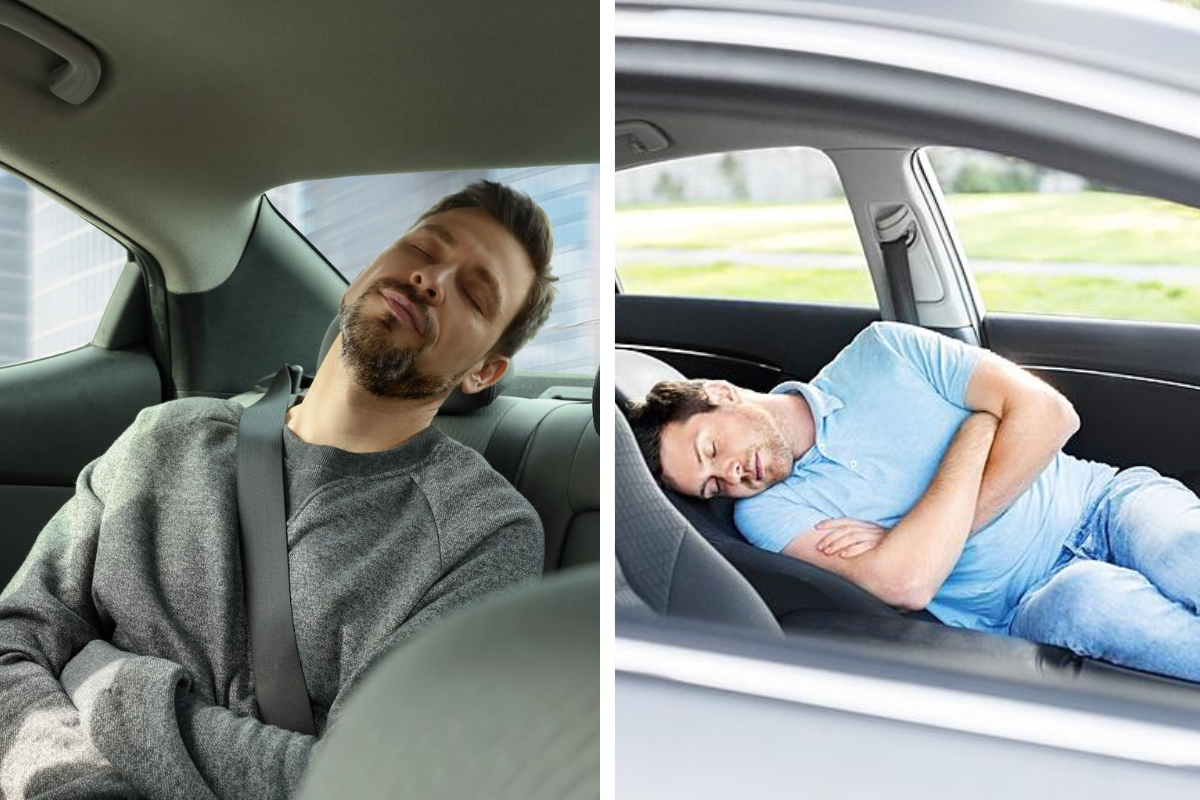
If you literally cannot afford wood, you can sleep on the folded-down seats with extra padding. Layer blankets, foam pads, or even cardboard to level the surface. This is uncomfortable for more than a few nights and will likely cause back pain, but it works as a temporary measure. The platform build should be your first priority once you have any funds at all.
Stealth and Organization
Blackout curtains are non-negotiable. Dark fabric and clothespins or velcro create privacy without drilling holes. Crack windows slightly for ventilation—rain guards help hide this gap. Park facing away from traffic so headlights don't illuminate your interior.
For organization, inexpensive accessories under $20 can make a significant difference: sun visor clips for storing documents, cup holder inserts for stability, a trunk organizer (even a cardboard box works) for categorizing supplies source. The goal is to prevent clutter from accumulating on the seats and floor, which signals to police and passersby that someone is living in the vehicle.
3. Iowa's Extreme Weather: Survival Without Spending

Winter: Below Zero is Not a Joke
Iowa winters regularly drop below 0°F, and wind chills can make it feel like -20°F or worse. The evidence on winter survival in vehicles converges on a critical point: never use propane, charcoal, or open-flame heaters inside the vehicle source. Carbon monoxide poisoning is silent, rapid, and fatal. This is not negotiable.
Instead, insulation and layering are your strategies. Thermal sun shades on all windows reflect body heat back into the vehicle. Thick floor mats (scavenged or cheap) on the cargo area and front footwells prevent heat loss through the floor. Fleece seat covers and wool blankets (check thrift stores) provide insulation when layered properly. Seal door gaps with temporary weatherstripping or even rolled-up fabric source.
Parking location is critical: windbreaks like buildings, evergreen trees, or berms can reduce wind exposure by 50% or more. This is free and dramatically effective.
For warmth without engine idling, battery-powered heated blankets (low wattage) can work, but they drain batteries quickly and require recharging. Hand warmers (the chemical type that activate when exposed to air) cost about $1 per pair and provide 6-8 hours of heat. A warm water bottle in an insulated sock placed at your feet can make the difference between sleeping and shivering. Layer clothing strategically: thermal base layer, wool middle layer, windproof shell. A hat and mittens are essential—you lose most heat through your head and extremities source.
If you have occasional access to an electrical outlet (truck stop restrooms, campground facilities), a low-wattage space heater can be used with extreme caution. This is a luxury, not a strategy.
The Block Heater Question
An engine block heater helps with cold starts and reduces fuel consumption. If you can find one used or cheap, install it. Otherwise, use synthetic oil that flows better in cold temperatures. Starting a cold engine repeatedly without a block heater will wear it faster, but a 2005 Jeep Liberty's 3.7L engine is robust and can handle it source.
Emergency Shelter
If winter becomes unmanageable—and it will—nonprofit winter shelters, churches, and Salvation Army locations often allow overnight stays for people in vehicles or provide warming centers. Research these locations before you need them. A list of Iowa warming centers is available through Iowa HHS source.
Summer: Beating the Humidity
Iowa summers are equally brutal, with temperatures above 90°F and humidity that makes it feel worse. The key difference from winter survival is that summer heat can be managed more passively, but it requires discipline.
Park in shade—this is free and reduces interior temperature by 15-20°F source. Use reflective sunshades on the windshield and side windows; towels or aluminum foil work in a pinch source source. Crack windows for cross-ventilation (rain guards help maintain stealth) and use a battery-powered or USB fan for airflow source source. These fans cost under $10 and run for hours on a power bank.
Hydration is critical. Keep a cooler with water and frozen bottles—they double as ice packs and cold water as they melt source. Wear breathable clothing (cotton or moisture-wicking) and use a damp cloth on your neck or wrists for evaporative cooling source source.
Avoid portable evaporative coolers—Iowa's humidity renders them useless source. This is a rare point of unanimous agreement among sources. Similarly, never run your car's A/C while sleeping—it's expensive, wastes fuel, and risks carbon monoxide poisoning if the vehicle is parked in an enclosed or poorly ventilated space.
Legal window tint, if you can afford it, blocks UV and slows interior heating source. Thrift stores occasionally sell window tint kits for under $10.
4. Connectivity: Free Wi-Fi and Digital Survival
The Wi-Fi Ecosystem
Staying connected is not optional—it's essential for job hunting, accessing assistance programs, navigation, and maintaining contact with support networks. Iowa has a surprisingly robust free Wi-Fi ecosystem, and multiple sources confirm the same core locations:
Public libraries top every list. They're quiet, secure, require no purchase, and most Iowa libraries allow extended use source source. This is where you can spend hours filling out job applications, applying for SNAP benefits, or researching relocation options.
Iowa DOT rest areas offer free Wi-Fi as a standard amenity source. This is particularly valuable because you're already rotating through rest areas for sleeping—you can charge devices and browse while staying legally compliant.
Fast-food chains (McDonald's, Starbucks, etc.) offer parking-lot Wi-Fi that often works without purchasing anything source. Be respectful of business hours and don't linger overnight. Some McDonald's locations have 24-hour Wi-Fi that works in the parking lot after closing.
Coffee shops and cafes in cities like Des Moines, Cedar Rapids, Iowa City, and Davenport are typically more welcoming than fast-food chains source. A $1 cup of coffee buys you an hour of internet in a climate-controlled environment.
Planet Fitness offers showers plus Wi-Fi for $10/month. If you can scrape together that $10, it transforms your hygiene and connectivity options.
Crowdsourced Solutions
Three apps stand out for finding Wi-Fi hotspots nationwide: WiFi Map source, WiFi Space (with 300,000+ hotspots globally including Iowa) source, and Kadama which shares user-submitted passwords source. These are zero-cost and work while you're relocating. The consensus among car-dwelling communities is that WiFi Map is the most reliable for Iowa specifically.
Security Warning
All sources agree on one critical precaution: always use a VPN when connecting to free Wi-Fi for sensitive activities like banking, job applications, or accessing government assistance portals source. Free VPNs exist—ProtonVPN offers a free tier with no data limits, though speeds are slower. Disable auto-connect on your devices and always verify network names with staff to avoid rogue hotspots designed to steal credentials.
5. Low-Cost Resources and Assistance Programs in Iowa
Food Assistance
SNAP (Supplemental Nutrition Assistance Program) is your primary food resource. Apply through Iowa HHS at 877-937-3663 or online source. Benefits are loaded onto an EBT card that works at grocery stores and some farmers markets. For someone with no money, this is transformative—it means you can eat without spending cash, which preserves funds for vehicle maintenance, gas, and emergencies.
Emergency food assistance programs and food pantries exist throughout Iowa source. Many operate on a "no questions asked" basis. Some churches offer free meals multiple times per week. Research locations in the counties you're rotating through.
Cash and Energy Assistance
Cash Assistance (TANF/FIP) provides temporary financial help for individuals or families source. The application process requires documentation, but if you have no address, you can use a general delivery address at a post office or a shelter's mailing address.
LIHEAP (Low-Income Home Energy Assistance Program) helps with utility bills. This might seem irrelevant for someone living in a car, but some sources suggest it can cover propane or generator fuel if you have a stable address for receiving the benefit source. This is worth exploring.
Employment and Housing Support
PROMISE JOBS offers job training and employment support, and can assist with relocation if needed source. This is particularly relevant given your willingness to relocate—PROMISE JOBS may help with transportation costs or moving expenses.
PATH (Housing & Homelessness Transition) provides case management and referral to shelters source. This is your pathway out of car living. Engage with PATH early, even if you're not ready to leave your vehicle—case managers can help with long-term planning.
Finding Resources on the Ground
The apps mentioned earlier—iOverlander, AllStays, TruckMap, FreeRoam—aren't just for parking spots. They contain user-verified information about water refill stations, dump stations, and free amenities source. Always check recent reviews; a "free water" spot that's been dry for three months won't help you.
6. Relocation Strategy: Finding Your Best Location
Why Rural Iowa Works
Your willingness to relocate is your greatest asset. Rural Iowa counties—Adair, Audubon, Guthrie, and similar—have fewer parking restrictions, more tolerant communities, and lower law enforcement presence. The trade-off is fewer resources (fewer libraries, fewer food pantries, longer drives between amenities). But the legal safety and reduced stress often outweigh these costs.
Checking Local Laws
Before moving to a new county, check city and county websites for overnight parking ordinances. Call the local police non-emergency line and ask directly: "Are there any ordinances against sleeping in a vehicle in this town?" Most dispatchers will answer honestly. Some will even recommend specific legal spots.
The Neighboring States Option
According to a comprehensive 2026 state-by-state analysis, 37 states (including Iowa, Illinois, Minnesota, Missouri, Nebraska, South Dakota, and Wisconsin) are fully legal for sleeping in your car at rest areas and truck stops; 13 states have restrictions source. This means you have options beyond Iowa. Minnesota has similar winter challenges but more robust social services. Missouri is warmer in winter but has fewer rest areas. South Dakota and Nebraska are more sparsely populated with even fewer restrictions.
Private Property Permission
Farmers, churches, and landowners in rural Iowa are often surprisingly accommodating if you ask respectfully. Offer to leave no trace, park discreetly, and move on in the morning. Some churches have dedicated overnight parking for travelers. This is not guaranteed, but it's free to ask.
The 24-Hour Rule
Regardless of location, the 24-hour rotation principle holds. Even in the most tolerant rural county, staying more than one night in the same spot increases the likelihood of complaints. The exception is if you have explicit permission from a property owner to stay longer.
7. Safety, Maintenance, and Long-Term Sustainability

Vehicle Maintenance on a Zero Budget
Your Jeep Liberty is your home—its reliability is non-negotiable. Basic maintenance (oil changes, tire rotations, fluid checks) can often be done for free at DIY auto shops or with borrowed tools from friends. Some car-dwelling communities organize maintenance meetups where experienced mechanics help newcomers for free.
The 2005 Liberty's 3.7L engine is known for two common issues: the cooling system (water pumps fail around 100,000 miles) and the transmission (torque converters can fail). Watch for signs of overheating (temperature gauge spikes) and transmission slipping (delayed engagement, hard shifts). Ignoring these issues will leave you stranded.
Emergency Kit
Your vehicle should always contain: water (at least 1 gallon per day for 3 days), non-perishable snacks (protein bars, nuts, canned goods with pop-tops), a flashlight with extra batteries, a power bank for charging devices, warm clothes and blankets (even in summer—Iowa weather can change rapidly), sun protection (sunscreen, hat, sunglasses), and a basic first aid kit source. This kit costs under $30 if assembled from thrift stores and dollar stores.
The Psychological Challenge
No guide to car living is complete without addressing the mental toll. Isolation, lack of privacy for personal tasks, constant vigilance against police and thieves, and the physical discomfort of extreme temperatures will wear on you. The evidence suggests that maintaining a routine—waking at the same time, visiting libraries for internet, rotating spots predictably—provides psychological stability. Engaging with support services (PATH, PROMISE JOBS) not only helps materially but provides human contact.
The Exit Strategy
Car living is a temporary solution, not a permanent lifestyle. The goal is to stabilize your situation—secure benefits, find employment, save money—so you can transition to stable housing. PATH case managers can help with this. Set small goals: first week, get SNAP benefits. Second week, find a reliable Wi-Fi spot. Third week, apply for jobs. Fourth week, save $50. The Jeep Liberty can be your platform for recovery, not your permanent home.
8. Final Safety and Legal Checklist
| Action | Why | Source |
|---|---|---|
| Carry valid insurance & registration | Required by law; proof of ownership helps with police encounters | source |
| Never sleep with engine running | Carbon monoxide poisoning, attracts attention, illegal in many areas | source |
| Keep keys outside vehicle if intoxicated | Avoid OWI charges | source |
| Rotate spots every 24 hours | Reduces suspicion and prevents "camping" citations | source |
| Use blackout curtains & low profile | Prevents theft and police checks | source |
| Check local ordinances weekly | Rules can change | source |
| Stay sober and polite | Avoiding conflict is the cheapest strategy | Multiple sources |
| Keep emergency supplies (water, food, flashlight, power bank, warm clothes, sun protection) | Essential for rural travel, winter cold, and summer heat | source |
| Use a VPN when connecting to free Wi-Fi | Protects sensitive information | source |
| Summer: park in shade, crack windows, use battery fan, stay hydrated | Avoid dangerous heat exposure and save fuel | source source |
Emergency numbers: Iowa HHS (for SNAP/LIHEAP): 877-937-3663. Non-emergency police line in rural areas is often more helpful than 911 for asking about parking.
Conclusion

Living out of a 2005 Jeep Liberty in Iowa on little to no money is not easy—but it is feasible. The evidence consistently shows that success depends on three pillars: legal awareness (knowing where you can sleep safely, avoiding OWI charges, rotating locations), vehicle preparation (removing the rear seats, building a low-cost sleeping platform, insulating for extreme weather), and resource utilization (SNAP benefits, free Wi-Fi at libraries and rest areas, shelter programs when conditions become dangerous).
Your willingness to relocate is transformative. Rural Iowa counties offer legal safety and community tolerance that urban areas cannot match. Neighboring states expand your options further. The 2005 Jeep Liberty, with its boxy shape and robust 3.7L engine, is a capable platform for this lifestyle—but only if you address its design limitations (the non-flat folding seats) with the platform solution described here.
The most important finding across all sources is this: car living in Iowa is a temporary survival strategy, not a long-term solution. Engage with PATH, PROMISE JOBS, and other assistance programs early. Use the stability of your Jeep Liberty to secure benefits, find employment, and save toward stable housing. The goal is not to master car living indefinitely—it's to use this challenging period as a bridge to something better.
No single source provides all the answers, but the convergence of evidence from legal experts, car-dwelling communities, Iowa assistance programs, and survival specialists creates a clear, actionable roadmap. Follow it, adapt it to your specific circumstances, and remember that every day you survive is a day closer to stability.