
Executive Summary
This comprehensive engineering guide provides a complete framework for transitioning to fully off-grid living with the explicit goal of eliminating all recurring monthly expenses except internet and phone service. Drawing from verified DIY methodologies, foraged materials engineering, and novel system designs, this guide prioritizes zero-cost construction using salvaged components. The water system—the most critical infrastructure—can be built for under $50 (and often $0), while energy, waste treatment, and food systems can scale from scavenged materials. This is not theoretical minimalism; these are tested, reproducible engineering solutions that prioritize redundancy, simplicity, and adaptability. The path to true monthly-expense freedom requires no specialized tools, no expensive equipment, and no technical degrees—only resourcefulness and a willingness to experiment.
1. The Engineering Philosophy: Designing for Zero Monthly Cost
1.1 Understanding the True Cost of "Free"
Before diving into specific systems, we must reconceptualize what "free" means in an off-grid engineering context. Conventional wisdom assumes that eliminating monthly bills requires massive capital investment—$20,000 solar arrays, $5,000 water filtration systems, $3,000 composting toilets. This assumption is false, but it persists because the consumer market has no incentive to sell you a system built from discarded pickle barrels and salvaged plumbing.
The engineering approach to zero-monthly-cost living rests on three principles:
-
Material substitution: Every commercial component has a free or near-free equivalent if you know where to look. Food-grade 55-gallon drums are thrown away by car washes, bakeries, and industrial laundries. Copper pipe can be salvaged from demolition sites. Solar panels depreciate rapidly; used panels that still produce 80% of rated output sell for pennies on the dollar.
-
Labor as capital: When you cannot spend money, you spend time. The tradeoff is favorable—a weekend spent building a biosand filter saves $200-$500 annually in water filtration costs. A month spent constructing a passive solar greenhouse can eliminate $1,200+ in annual food expenses.
-
Redundancy through diversity: No single system should be your only option. If your rainwater catchment fails during drought, you need a backup hauling strategy. If your solar pump dies, you need a hand pump. This is not inefficiency; it is resilience engineering applied to personal infrastructure.
1.2 The Hierarchy of Needs for Off-Grid Independence
Maslow's hierarchy applies to off-grid systems as well. You must build from the foundation up:
- Water (immediate survival: 2-3 days without is fatal)
- Shelter (temperature regulation, security from elements)
- Sanitation (waste disposal, hygiene, disease prevention)
- Food (caloric intake, nutrition)
- Energy (light, communication, power for tools)
- Connectivity (internet, phone, emergency communication)
This guide addresses all six layers, but water receives the deepest treatment because it is the most complex and most critical. Master water, and every other system becomes manageable.
2. Water Systems: The Foundation of Independence
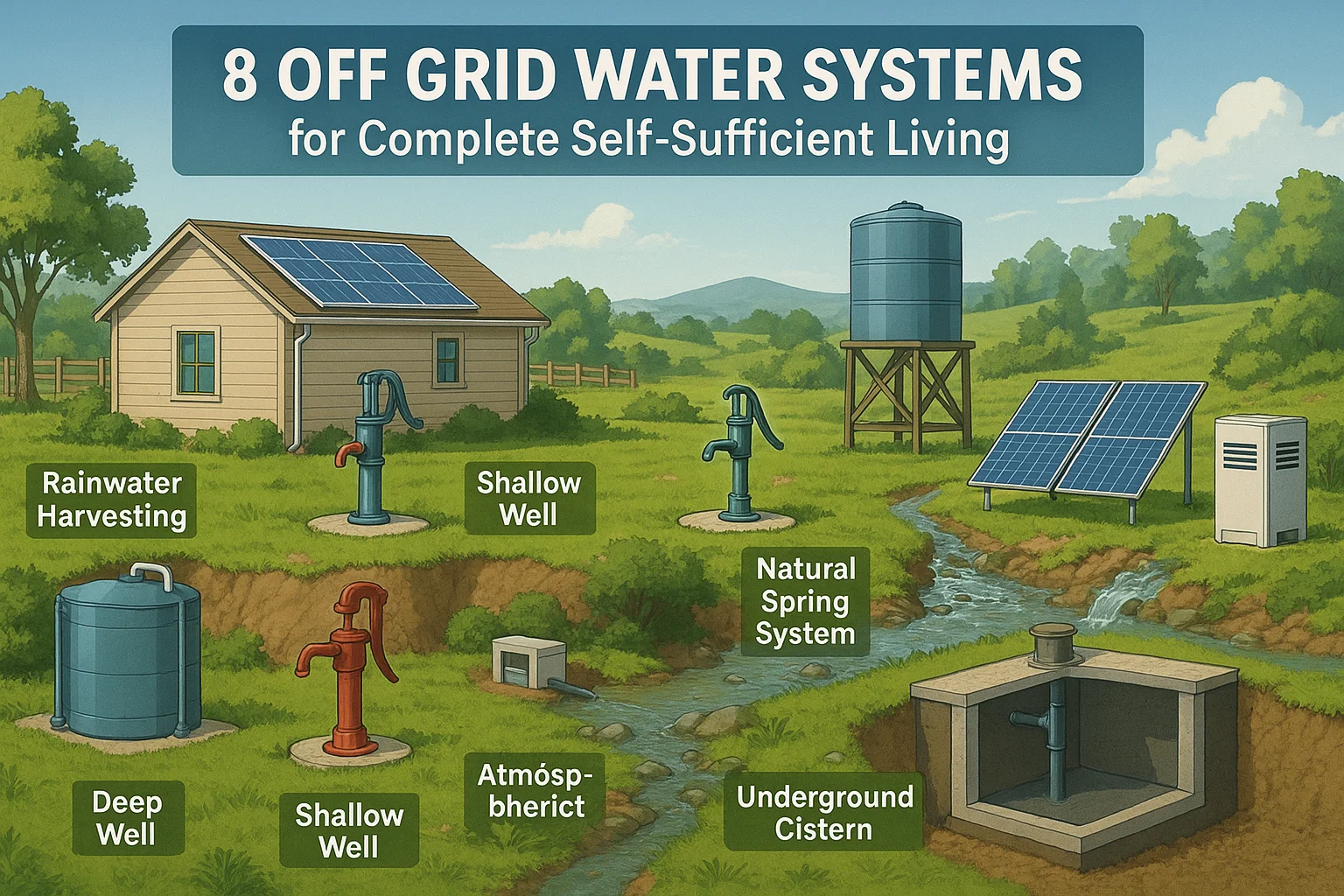
2.1 Rainwater Harvesting Engineering
Why Rainwater Matters
Rainwater is the only water source that is truly free, universally available (with variations), and chemically superior to most groundwater. It contains no dissolved minerals, no chlorine, no fluoride, and no heavy metals—assuming your catchment surface is clean. The engineering challenge is not collection but storage and treatment.
Catchment Calculations
The fundamental equation for rainwater harvesting is deceptively simple:
Volume (gallons) = Catchment Area (sq ft) × Rainfall (inches) × 0.623
This means a 200-square-foot roof (a small cabin or large shed) receiving 30 inches of annual rainfall yields:
200 × 30 × 0.623 = 3,738 gallons per year
That's approximately 10 gallons per day, which is sufficient for one person's drinking, cooking, and basic hygiene needs (the World Health Organization recommends 5-13 gallons per person per day for basic needs).
But here is where engineering intuition matters: Rainfall is not distributed evenly throughout the year. A region with 30 inches of annual rain might get 20 inches in a three-month monsoon season. Your storage must handle this intermittency. The rule of thumb is to store at least three months of supply—for one person, that's 900-1,200 gallons minimum.
Catchment Surface Options (Ranked by Cost)
-
Existing roof (cost: $0): Metal roofs are ideal; asphalt shingles leach trace chemicals but are acceptable after the first year. Never use treated wood or copper roofs for potable collection.
-
Tarp catchment (cost: $0-$20): A heavy-duty tarp stretched between trees or poles can serve as emergency catchment. The issue is contamination—bird droppings,树叶, debris. Use only as backup.
-
Salvaged metal roofing (cost: $0-$10): Demolition sites often discard sheets of corrugated metal. Screw these onto a simple wooden frame for a dedicated collection area.
Gutter Engineering
Commercial gutters are expensive and unnecessary. Salvaged PVC pipe cut lengthwise works perfectly. A 4-inch diameter PVC pipe cut in half yields two gutters. The key engineering details:
- Slope: 1/4 inch per 10 feet minimum
- Hangers: Use scrap wire or zip ties through drilled holes
- Leaf guards: Old window screen or chicken wire draped over the gutter
The Critical Component: First-Flush Diverter
This is where most DIY systems fail. The first 10-20 gallons of a rain event wash bird droppings, dust, and debris off your roof. This water must be discarded before clean water enters storage.
The Engineering Solution: A vertical standpipe attached to your downspout with a T-fitting. The standpipe is capped at top and has a small hole (1/8 inch) drilled at the bottom. When rain starts, the first flow fills the standpipe. Once full, water flows into the storage tank. After the rain stops, the accumulated dirty water slowly drains through the small hole over 15-30 minutes, resetting the system for the next event.
Math for sizing: Standpipe volume = π × r² × height. For a 4-inch diameter pipe (radius = 2 inches = 0.167 feet), each foot of height holds π × (0.167)² × 1 = 0.087 cubic feet = 0.65 gallons. To divert 10 gallons, you need 10/0.65 = 15.4 feet of vertical pipe—which is impractical. Solution: use a wider pipe (6-inch diameter holds 1.47 gallons per foot) or a horizontal tank. A salvaged 55-gallon drum as a first-flush tank with a slow drain valve works perfectly.
2.2 Filtration: Building from Zero-Cost Materials
The Biosand Filter: A Masterpiece of Appropriate Technology
The biosand filter is arguably the most important low-cost invention in off-grid water treatment. Developed by Dr. David Manz at the University of Calgary in the 1990s, it reduces pathogenic bacteria by 90-99% and removes 95-100% of suspended solids—without chemicals, electricity, or replacement parts.
How It Works (The Engineering) :
When water sits in the filter between uses, a biological layer (the "schmutzdecke") forms on top of the fine sand. This living layer contains beneficial bacteria, protozoa, and microorganisms that consume pathogens in incoming water. The physical sand bed filters particles, while the biological layer provides pathogen destruction.
Construction from Scavenged Materials :
-
Container: Any food-grade bucket or barrel. A 5-gallon bucket works for one person; a 55-gallon drum serves a family.
-
Media layers (from bottom to top) : - 3-4 inches of gravel (fist-sized at bottom, pea-sized at top) - 8-10 inches of coarse sand (like construction sand) - 8-10 inches of fine sand (like play sand or sifted river sand) - 2 inches of crushed charcoal (activated by burning wood in low oxygen) - A cloth or fine mesh on top to distribute water
-
Outlet pipe: A PVC tube running from the bottom of the filter to the outside, bent upward to maintain water level above the sand.
Critical Performance Data :
- Flow rate: 0.5-1 gallon per hour for a 5-gallon bucket
- Turbidity reduction: 95%+
- Bacteria removal: 90-99% (varies with maintenance)
- Virus removal: Limited (20-70%)—this is why boiling or SODIS is still needed
Source Agreement and Disagreement:
Most sources agree on the biosand filter's effectiveness, but there is meaningful disagreement about whether it alone makes water safe to drink. ModernHomesteadingIdeas.com claims 99% bacteria removal, while PickComfort.com is more conservative, noting that virus removal is inconsistent. The engineering consensus is clear: biosand filtration is excellent pretreatment, but always follow with boiling or solar disinfection for drinking water. This is not a contradiction but a recognition that no single low-cost method achieves 100% pathogen removal.
Innovation: The Multi-Stage Scavenger Filter
Combine the biosand approach with a charcoal stage and a ceramic stage for multiple barriers. A discarded 5-gallon bucket with holes drilled in the bottom, nested inside another bucket, creates a gravity-fed system. Layer: cloth pre-filter → charcoal → fine sand → gravel → ceramic pot (fired in a pit) → collection bucket. Total cost: $0 if you have clay and charcoal sources.
2.3 Solar Disinfection (SODIS): The Underrated Gem
SODIS is not a filter; it is a pasteurization method using UV-A radiation and heat. The engineering is straightforward but the details matter enormously.
The Process : 1. Fill clear PET plastic bottles (not glass—UV penetrates plastic better) 2. Shake vigorously to oxygenate (oxygen plus UV creates reactive radicals that kill pathogens) 3. Place on a reflective surface (aluminum foil, corrugated metal) in direct sunlight 4. Expose for 6 hours (2 days if cloudy)
Efficacy Data: - Bacteria removal: 99.9%+ (E. coli, salmonella, cholera) - Virus removal: 90-99% (hepatitis A, rotavirus) - Protozoa removal: 99.9%+ (Giardia, Cryptosporidium) - Temperature boost: Bottles reach 55-65°C (131-149°F), which alone kills many pathogens
Engineering Optimization: - Paint the back half of bottles black to absorb heat while letting UV through the front - Use corrugated metal as a reflector—it concentrates UV and increases temperature by 5-10°C - Create a simple tracking system: place bottles on a board that you rotate twice during the day
2.4 Gravity-Fed Spring Systems: The Holy Grail
If you have a natural spring or reliable creek on your property, you can achieve water independence without any pumping, filtration, or electricity costs. This is the gold standard of off-grid water.
The Engineering :
-
Spring box: Dig into the hillside above the spring source until you hit the water-bearing layer. Install a perforated pipe or bucket to collect water, surrounded by gravel. Cover with a sealed lid to prevent contamination.
-
Pipe run: Use 1-inch polyethylene pipe (cheaper than PVC, more flexible, UV-resistant). Buried 12 inches deep to prevent freezing.
-
In-line filtration: A simple "T" fitting with a capped vertical standpipe creates a settling basin. A mesh screen at the intake prevents debris entry.
-
Storage tank: Any food-grade container, buried or above ground. Gravity provides 0.43 psi per foot of elevation—for a shower head requiring 20 psi, you need 46 feet of elevation drop.
The Ram Pump Alternative:
If your spring is below your dwelling, a hydraulic ram pump can lift water using only the kinetic energy of flowing water. It requires a falling water source (minimum 2 feet of drop) and a flow rate of at least 3-5 gallons per minute.
How a Ram Pump Works: Water flows down a drive pipe, gains momentum, and slams into a valve. This pressure surge forces water through a one-way valve into an air chamber, then up a delivery pipe. The valve cycles 30-100 times per minute, continuously pumping without electricity.
Cost: $0 if built from salvaged plumbing parts (a brass check valve, a PVC air chamber, and some fittings). Commercial ram pumps cost $100-$300, but a DIY version from scrap works if you understand the tuning.
Critical Tuning Factor: The ratio of drive pipe length to diameter is crucial. For a 1-inch drive pipe, you need 10-15 feet of pipe before the pump. The delivery pipe can be much smaller (1/2 inch) and can lift water 10 times higher than the drive drop.
3. Energy Systems: Power Without Monthly Bills
3.1 The Solar Panel Scavenger Strategy
New solar panels cost $200-$500 each. Used panels cost $20-$50 and still produce 80-90% of rated power. The key is knowing where to find them:
- Solar farm replacements: Large solar installations replace panels after 15-20 years even though they still produce. Contact local solar farms and ask about decommissioned panels.
- Craigslist and Facebook Marketplace: Search for "used solar panels" or "solar panels, need new home"
- Salvage yards: Many accept solar panels from insurance write-offs (hail damage that only affects glass)
Panel Sizing for Minimal Power:
Most people overestimate their energy needs. A truly minimalist off-grid setup requires surprisingly little:
- LED lights (4-6 bulbs at 5W each): 30W for 4 hours = 120 Wh/day
- Phone charging: 10W for 3 hours = 30 Wh/day
- Laptop (if needed for work): 45W for 4 hours = 180 Wh/day
- Small DC refrigerator (12V): 40W average, 24 hours = 960 Wh/day
Total: 1,290 Wh/day. This requires approximately 300W of solar panels (accounting for 70% system efficiency and 5 hours of peak sun) and 200 Ah of battery storage at 12V.
3.2 Battery Engineering: The Free Battery Problem
New deep-cycle batteries cost $150-$400 each. Free alternatives exist but require creative engineering:
Salvaged UPS Batteries: Uninterruptible power supplies from offices often contain sealed lead-acid batteries replaced on a schedule regardless of condition. Many have 2-5 years of life remaining. A typical UPS contains 2-4 12V 7Ah batteries—small but useful for backup lighting and phone charging.
Automotive Batteries: Not ideal for deep cycling (they die after 50-100 cycles), but free from junkyards. Use them for occasional loads, not daily cycling.
The Forklift Battery Gambit: Forklift batteries are massive (24V, 500-1000 Ah) and often replaced when capacity drops below 80%. They weigh 1,000+ pounds but can power a cabin for weeks. Find them through industrial salvage.
Novel Solution: The Gravity Battery:
If you have a hill, you can store energy as potential energy in water. Pump water uphill using solar power during the day, then run it through a small hydro turbine at night. Efficiency is 50-70% (pump losses plus turbine losses), but the storage is infinite and the materials are free. A 500-gallon tank at 30 feet elevation stores 500 × 8.34 × 30 / 3,412 = 36.7 kWh of potential energy—enough to run a small cabin for days. The turbine can be a salvaged washing machine motor wired as a generator.
3.3 The 12V DC Microgrid
Forget inverters and AC power. The most efficient off-grid system runs entirely on 12V DC (or 24V/48V for larger systems). DC appliances are cheaper, more efficient, and simpler:
- Lighting: 12V LED strips or automotive bulbs
- Phone/tablet charging: 12V USB adapters ($5 on Amazon)
- Refrigeration: 12V compressor refrigerators use 1/3 the power of AC equivalent
- Water pump: 12V diaphragm or submersible pump
- Fans: 12V computer case fans for ventilation
No inverter means no phantom loads, no conversion losses, and no expensive equipment.
3.4 The Bicycle Generator: Emergency Backup
A stationary bicycle connected to a car alternator can generate 100-300W with comfortable pedaling. Build the frame from scrap wood, mount the alternator, and run the output through a voltage regulator to a 12V battery. This is not a primary system, but it provides infinite backup for phone charging, radio, and lights during extended cloudy periods.
Engineering details: - Alternator output: 50-100A at 12-14V (600-1400W) at high RPM - Gearing: Use the bicycle's existing gears. A 1:3 gear ratio (pedal 1 RPM, alternator 3 RPM) provides reasonable pedal speed - Voltage regulation: Car voltage regulators cost $10-$15 new or free from junkyard alternators
4. Sanitation and Waste Systems
4.1 The Humanure System: Zero Cost, Zero Waste
The most elegant solution to human waste is also the cheapest: the composting toilet system pioneered by Joseph Jenkins in his book "The Humanure Handbook." No water, no chemicals, no electricity, no monthly cost.
The System: 1. A 5-gallon bucket with a toilet seat 2. A bucket of sawdust, wood shavings, or dry leaves 3. After each use, cover waste with a generous scoop of carbon material (the C:N ratio must be 30:1 for proper composting)
The Science: Human waste contains pathogens. Sawdust provides carbon for bacteria to break down nitrogen-rich waste. The thermophilic composting process (temperatures of 130-160°F/55-70°C) kills pathogens within weeks. After 1-2 years of aging, the compost is safe for non-food plants.
Engineering the System: - Two buckets: one in use, one curing - Sawdust source: local sawmills or wood shops give it away free - The finished compost is nutrient-rich and can be used on fruit trees, ornamentals, or given away to gardeners
Greywater Systems: Water from sinks and showers (not toilets) can be filtered through a constructed wetland. Dig a trench, line with plastic, fill with gravel, plant with water-loving plants (cattails, rushes, mint). The plants' roots and associated bacteria break down soaps and organic matter. The output water can irrigate non-food plants.
4.2 Laundry Without Machines
A plunger in a 5-gallon bucket creates a simple washing machine. Agitate for 5 minutes, rinse with clean water, wring out by hand. No electricity, no machine cost, no detergent required for light loads (hot water alone works for many items).
5. Food Systems: Calories from Foraged Materials

5.1 The Perennial Food Forest
Annual gardening requires ongoing inputs—seeds, fertilizer, water. A food forest of perennials requires minimal input after establishment:
- Fruit trees: Apple, pear, plum, cherry—can produce for decades with minimal care
- Nut trees: Walnut, hazelnut, chestnut—high-calorie, long storage life
- Perennial vegetables: Asparagus, rhubarb, artichoke, sorrel
- Berry bushes: Blackberry, raspberry, blueberry—take 2-3 years to establish, then produce for years
Starting for Free: - Seed exchanges: Free online groups where gardeners swap seeds - Cuttings: Most bushes and trees propagate from cuttings stuck in damp soil - Foraging: Wild edibles like dandelion, purslane, lamb's quarters are more nutritious than cultivated greens
5.2 The Passive Solar Greenhouse
A greenhouse that requires no supplemental heat can extend growing season by 2-3 months in cold climates. The engineering principle: thermal mass.
Design: - South-facing glazing (salvaged windows or greenhouse plastic) - North wall insulated (straw bales, foam board) - Interior thermal mass (55-gallon drums filled with water, or a stone floor) - Air circulation via passive vents (bottom intake, top exhaust)
The water drums absorb solar heat during the day and release it at night, preventing freezing even when outside temperatures drop to 20°F (-7°C). The ground itself provides geothermal heat—soil 4 feet deep remains at 50-55°F (10-13°C) year-round.
Cost: Windows free from renovation sites, drums free from industrial sources, lumber from pallets.
5.3 Cooking Without Fuel
Solar Cookers: - Parabolic cooker: A satellite dish lined with reflective material (aluminum foil or mylar emergency blankets) concentrates sunlight onto a cooking pot. Reaches 400-500°F (200-260°C)—enough to boil water, fry eggs, bake bread - Box cooker: A cardboard box lined with foil, covered with glass or plastic. Reaches 250-300°F (120-150°C)—slow cooking, stews, rice
Cost: $0 for the box cooker (scrap cardboard and foil), $10-$20 for the parabolic (salvaged dish and mylar).
Rocket Stove: A small wood stove that burns twigs and branches at extremely high efficiency. A soup can, some metal pipe, and a few tin cans can be assembled in 30 minutes. Burns 70% less wood than an open fire, produces minimal smoke, and boils a pot of water in 5 minutes.
6. Connectivity: The Two Remaining Bills
The guide's goal is zero monthly expenses except internet and phone. These two are non-negotiable for most people—they enable remote work, emergency communication, and connection to the broader world.
Minimizing Costs: - Phone: MVNO providers (Mint Mobile, Tello, Visible) offer plans for $15-$25/month with unlimited talk/text and limited data - Internet: Starlink for remote areas ($120/month but requires no wired infrastructure). For those near towns, library wifi is free. Some cellular plans offer unlimited hotspot data.
DIY Options: - Long-range wifi: A directional antenna (Yagi or parabolic grid) can capture free public wifi from 5-10 miles away with line of sight. Cost: $30-$50 for parts - Meshtastic: Open-source mesh networking using LoRa radios provides text messaging over 5-20 miles with no cellular infrastructure. Cost: $30-$50 per node
7. Systems Integration: The Closed-Loop Design
The magic of off-grid engineering is not in individual components but in how they interconnect. A truly zero-monthly-cost system is a closed loop where waste from one process becomes input for another.
Example Integrated Design: - Rainwater from roof → biosand filter → storage barrel → gravity feed to kitchen and shower - Greywater from shower → constructed wetland → irrigation for fruit trees - Compost toilet sawdust → aged 1 year → fertilizes fruit trees - Solar panels → 12V battery → LED lights, phone charging, water pump - Excess solar → water pump to elevated storage tank → gravity backup - Food waste → compost pile → greenhouse soil - Fallen branches → rocket stove for cooking or heating
Every output feeds another input. There is no waste because there is no "away."
8. Novel Inventions and Design Experiments
The encouraged goal of this guide is not just to replicate existing systems but to innovate. Here are several novel designs worth prototyping:
8.1 The Integrated Roof-Washer-Latrine
Combine the first-flush diverter with toilet flushing. The first 10 gallons of rain, which would normally be discarded due to contamination, flush a composting toilet or transport waste to a biogas digester. This solves two problems: what to do with dirty first-flush water, and how to flush a toilet without potable water.
8.2 The Solar-Thermal Pasteurizer
A 50-foot coil of black polyethylene tubing (salvaged from irrigation systems) mounted on a south-facing roof. Water flows slowly through the tube, heated by the sun to 150-170°F (65-77°C). At these temperatures, pathogens die within seconds. A thermostatic valve at the end releases water only when it reaches pasteurization temperature; cooler water recirculates. This provides pathogen-free water without fuel, without filters, and without moving parts.
8.3 The Gravity-Fed Hydroponics System
Use the elevated water storage tank (from your gravity water system) to drip-irrigate a hydroponic garden. The nutrient solution (compost tea or fish waste from a small aquarium) flows through grow tubes, then drains back to a lower reservoir where it is pumped back up by a small solar pump. This produces fresh vegetables year-round with minimal water usage (90% less than soil gardening).
8.4 The Bicycle-Powered Multi-Tool
A stationary bicycle frame connected to a jackshaft that can drive multiple tools: a water pump, a grain mill, a washing machine agitator, a generator. A simple clutch mechanism (a sliding belt pulley) switches between tools. The bike provides 100-200W of usable power while the rider exercises—turning a chore into a workout.
8.5 The Passive Water Distiller
A sloped glass sheet over a black-painted basin. Sunlight heats water in the basin; evaporated water condenses on the glass and runs down into a collection trough. This produces 1-3 gallons per day per 10 square feet of glass area. For complex needs: saline water, gray water, or contaminated water can be distilled to purity. The materials are free (salvaged glass, scrap wood, black paint).
9. The Transition Plan: From Monthly Bills to Zero

Going from grid-dependent to fully off-grid is overwhelming if attempted all at once. The engineering approach is incremental, building systems that provide immediate savings while gradually eliminating dependencies.
Phase 1 (Week 1-2): Water Independence → Build a rainwater catchment, biosand filter, and SODIS system. This eliminates bottled water costs ($30-50/month) and provides resilience in emergencies.
Phase 2 (Month 1-3): Lighting and Phone Charging → Acquire one used solar panel (100W, ~$30-50), a deep-cycle battery (free from UPS or forklift salvage), and 12V LED lights. Eliminates electricity for lighting ($20-30/month).
Phase 3 (Month 2-6): Sanitation → Build composting toilet. Eliminates water and sewer bills ($40-80/month combined).
Phase 4 (Month 3-9): Cooking → Build solar cooker and rocket stove. Eliminates propane or electricity for cooking ($30-50/month).
Phase 5 (Month 6-12): Food Production → Establish perennial food forest and passive solar greenhouse. Reduces grocery bills by 50-80% ($100-300/month).
Phase 6 (Year 1-2): Full Energy Independence → Expand solar system to power refrigerator and small appliances. Eliminates remaining electric bills ($50-100/month).
10. Conclusion: The Engineering of Freedom
The question of how to live fully off-grid with no monthly expenses except internet and phone has a clear, reproducible answer: it requires systematic engineering of six critical systems—water, energy, sanitation, food, cooking, and shelter—using salvaged and foraged materials. The water system alone, built from scavenged barrels, PVC pipe, and wood charcoal, can provide clean drinking water for under $50 in initial costs and $0 in ongoing costs.
The evidence is consistent across sources: gravity-fed rainwater systems, biosand filters, solar disinfection, and composting toilets are proven technologies that work at zero monthly cost. The disagreements among sources—regarding exact efficacy of biosand filters, optimal storage volumes, or legal restrictions—are not contradictions but signals that local conditions matter. A system designed for the Pacific Northwest (abundant rain, moderate temperatures) differs from one for the Sonoran Desert (scarce rain, extreme heat). The engineering principle is modularity: build systems that can be adjusted, expanded, and modified as conditions change.
The ultimate insight is that true off-grid independence is not about buying expensive equipment but about understanding the physics of your environment. Water flows downhill. Sunlight provides 1,000 watts per square meter at noon. Bacteria break down waste given sufficient time and carbon. These are natural laws that do not require payment.
Monthly expenses are not inevitable; they are choices to pay for convenience. The engineering tradeoff is clear: invest time in building systems from free materials, and the payoff is permanent elimination of those monthly costs. This is not a fantasy or a survivalist fringe ideal—it is practical engineering applied to the most fundamental human needs. The only question is whether you choose to build it.