
Executive Summary: The laws of thermodynamics, conservation laws, quantum mechanics, and universal constants form an inviolable framework that constrains all possible technologies. No invention can create energy, achieve perfect efficiency, reach absolute zero, exceed the speed of light, or violate quantum uncertainty. However, these laws are not merely barriers—they are design foundations. Understanding them allows inventors to work creatively within natural boundaries, transforming apparent limitations into opportunities for innovation. This report synthesizes the key physical laws every technologist must understand, explains their practical implications, and shows how the most transformative technologies actually harness these constraints rather than fight them.
The Four Laws of Thermodynamics: The Foundation of All Energy Technology
The laws of thermodynamics are arguably the most consequential set of physical principles for technology development. They govern every process involving energy conversion, from the combustion engine in your car to the metabolic processes in your body to the operation of quantum computers. Understanding them is not optional—it is fundamental.
Zeroth Law: The Basis of Measurement
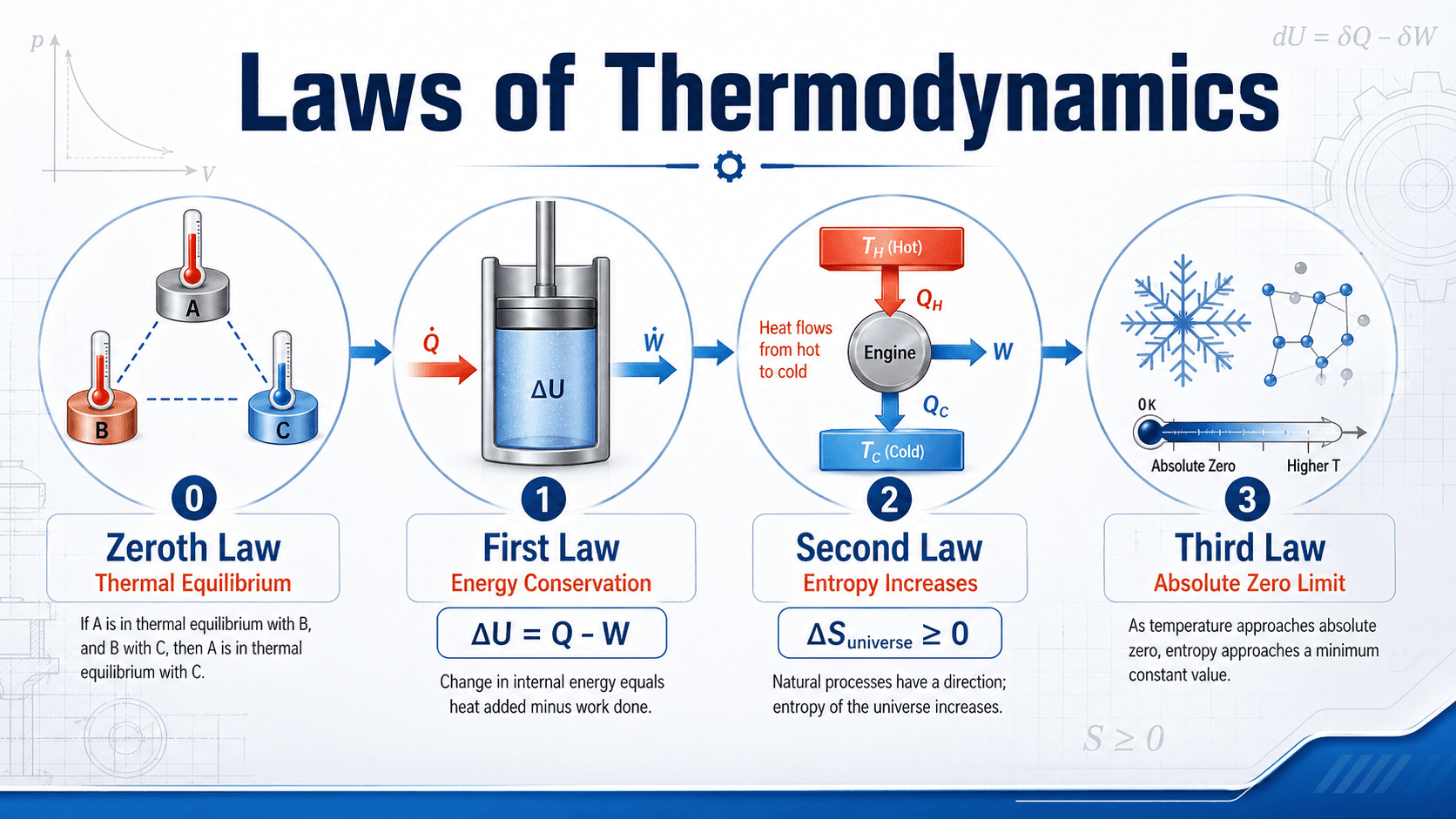
The Zeroth Law states that if system A is in thermal equilibrium with system B, and system B is in equilibrium with system C, then A and C are also in equilibrium [https://engineersguidebook.com/laws-of-thermodynamics-a-detailed-guide/]. This may seem trivial, but it is actually profound. It establishes temperature as a measurable, transitive property of matter. Without this law, we could not build thermometers or thermal sensors—or at least, we could not trust that they provide meaningful information about systems they are not in direct contact with.
For technology inventors, the Zeroth Law enables the entire field of thermal management. Every smartphone, data center, and electric vehicle relies on temperature sensors that depend on this principle. When engineers design cooling systems for computer chips that generate hundreds of watts per square centimeter, they depend on the Zeroth Law to ensure their temperature measurements are meaningful across different parts of the system.
First Law: The Energy Conservation Principle
The First Law of Thermodynamics states that energy cannot be created or destroyed, only transformed from one form to another. Mathematically, it is expressed as ΔU = Q - W, where ΔU is the change in internal energy, Q is heat added to the system, and W is work done by the system [https://galileo.phys.virginia.edu/classes/152.mf1i.spring02/LawsThermo.htm].
This law has one immediate and devastating implication for technology: perpetual motion machines of the first kind are impossible. No device can produce more energy than it consumes. Every proposed "free energy" device that claims to generate power from nothing violates this fundamental principle [https://engineersguidebook.com/laws-of-thermodynamics-a-detailed-guide/].
The First Law also sets an upper bound of 100% efficiency for any energy conversion process. In practice, this bound is never reached—real systems always lose some energy to heat, friction, or other forms of dissipation. But the First Law tells us that even in an ideal world, we cannot get more energy out than we put in.
For the technology inventor, this means that advances in energy technology must focus on efficiency improvements and energy capture rather than energy creation. Solar panels do not create energy—they convert sunlight into electricity. Batteries do not store energy—they store chemical potential energy. Every "energy breakthrough" ultimately reduces to better conversion, storage, or transfer of existing energy.
Second Law: The Arrow of Time and the Efficiency Ceiling
The Second Law of Thermodynamics is perhaps the most consequential for technology. It states that in any isolated system, entropy (a measure of disorder) always increases over time, and heat flows spontaneously from hotter to colder bodies [https://openoregon.pressbooks.pub/bodyphysics2ed/chapter/efficiencylimit/].
This law gives time its arrow—it tells us which processes are irreversible and which direction natural processes will proceed. For technology, the Second Law has multiple critical implications:
The Carnot Limit: No heat engine operating between two reservoirs at temperatures T_hot and T_cold can achieve an efficiency greater than η = 1 - T_cold/T_hot [https://galileo.phys.virginia.edu/classes/152.mf1i.spring02/LawsThermo.htm]. This is the Carnot efficiency, and it is absolute. A typical coal-fired power plant operates between about 600°C (873 K) and 40°C (313 K), giving a Carnot efficiency of about 64%. Real plants achieve about 35-40% efficiency—impressive but far from the theoretical limit. Gas turbines running at higher temperatures can approach 60% efficiency in combined-cycle plants [https://learn.sustainability-directory.com/learn/what-are-the-limits-of-thermodynamic-efficiency/].
Waste Heat is Inevitable: The Second Law forces all real energy converters to dump some input energy as waste heat. No process that converts heat to work can be 100% efficient [https://turn2engineering.com/mechanical-engineering/thermodynamics/laws-of-thermodynamics]. This means that data centers, power plants, internal combustion engines, and even biological metabolisms must reject heat to the environment.
No Single-Heat-Reservoir Engine: You cannot extract work from a single heat reservoir at uniform temperature—for example, you cannot build an engine that runs by cooling the ocean. There must always be a temperature difference to drive the engine [https://www.numberanalytics.com/blog/thermodynamic-constraints-ultimate-guide].
Gibbs Free Energy: The spontaneity of chemical reactions is governed by Gibbs free energy (ΔG = ΔH - TΔS), where ΔH is enthalpy change, T is temperature, and ΔS is entropy change [https://www.numberanalytics.com/blog/thermodynamic-constraints-ultimate-guide]. This determines which chemical processes are thermodynamically feasible and which require energy input.
Third Law: The Absolute Zero Barrier
The Third Law states that absolute zero (0 K or -273.15°C) is unattainable in a finite number of steps [https://engineersguidebook.com/laws-of-thermodynamics-a-detailed-guide/]. As a system approaches absolute zero, its entropy approaches a minimum value—zero for a perfect crystal.
This law limits cryogenic cooling technology. While we can reach temperatures within billionths of a degree of absolute zero using laser cooling and magnetic trapping, we can never actually reach 0 K. This has practical consequences for technologies that require extreme cold, such as superconducting magnets in MRI machines and particle accelerators, and the quantum processors in some quantum computers that must operate at millikelvin temperatures.
Key Implications for Technology Invention

Efficiency and Energy Conversion: The Practical Limits
The Carnot efficiency bound is not just a theoretical curiosity—it has direct, measurable impacts on technology development. Consider the following:
Solar Cells: Photovoltaic cells convert sunlight directly to electricity, bypassing the heat engine cycle. In principle, they are not bound by the Carnot limit because they involve quantum rather than thermal processes. However, they have their own fundamental limits. The Shockley-Queisser limit sets a maximum efficiency of about 33.7% for a single-junction solar cell operating under standard sunlight [https://learn.sustainability-directory.com/learn/what-are-the-limits-of-thermodynamic-efficiency/]. Modern commercial cells achieve about 20-25%, while multi-junction cells in laboratory settings have reached over 47%.
Internal Combustion Engines: Typical gasoline engines achieve 20-30% thermal efficiency, meaning 70-80% of the fuel's energy is wasted as heat. Diesel engines are somewhat better at 30-40%. The Carnot limit for typical operating temperatures (about 2500 K combustion temperature, 300 K exhaust) would be about 88%, but real engines fall far short due to irreversibilities like friction, heat loss through cylinder walls, and incomplete combustion [https://www.numberanalytics.com/blog/thermodynamic-constraints-ultimate-guide].
Fuel Cells: These devices convert chemical energy directly to electricity and can achieve higher efficiencies than heat engines because they bypass the thermal cycle. Proton exchange membrane fuel cells can reach 40-60% efficiency, while solid oxide fuel cells operating at high temperatures can exceed 60%. However, they are still subject to the Second Law's constraints on spontaneity via Gibbs free energy.
The key insight: Approaching thermodynamic limits requires increasingly exotic materials and exponentially rising costs. The difference between 20% and 40% efficiency might be achievable with good engineering, but going from 40% to 60% requires advanced materials, careful thermal management, and complex system designs. Reaching 80% of the Carnot limit for a heat engine typically demands materials that can withstand extreme temperatures and pressures, leading to skyrocketing costs [https://learn.sustainability-directory.com/learn/what-are-the-limits-of-thermodynamic-efficiency/].
Information Processing and Computing: The Thermodynamic Cost of Knowledge
Landauer's Principle, derived from the Second Law, states that erasing one bit of information in a computing device dissipates at least kT ln 2 joules of heat, where k is Boltzmann's constant and T is the operating temperature [https://plato.stanford.edu/entries/information-entropy/]. At room temperature (300 K), this is about 2.9 × 10⁻²¹ joules per bit—an incredibly small amount. Modern transistors dissipate millions of times more energy than this fundamental limit, but as transistor sizes continue to shrink and computing demands grow, Landauer's bound becomes increasingly relevant.
This principle establishes that information is physical. Any computing operation that involves information erasure must dissipate heat. This is not a limitation of current technology—it is a fundamental law of nature [https://arxiv.org/html/2506.10876v1].
The implications for future computing are profound:
Reversible Computing: If information is not erased—if all operations are logically reversible—then in principle, computing could be done without heat dissipation. This is a active area of research. Reversible computers would operate by preserving information throughout calculations, only erasing it at the very end when the final answer is needed. However, practical reversible computers remain experimental.
Quantum Computing: Quantum computers operate on fundamentally different principles. Quantum gates are unitary (reversible), so they can avoid Landauer's bound during computation. However, measurement—which extracts the answer—is irreversible and does dissipate heat. Additionally, quantum error correction, which is necessary for practical quantum computing, involves erasure of error information and thus incurs thermodynamic costs [https://arxiv.org/html/2506.10876v1].
Maxwell's Demon is Impossible: The famous thought experiment of a "demon" that could sort fast and slow molecules to decrease entropy without work is impossible. Any real demon (or its technological equivalent) would need to measure and remember information about molecules, and the act of erasing that information would generate at least as much entropy as the sorting process reduces [https://plato.stanford.edu/entries/information-entropy/]. This principle has been experimentally verified using nanoscale systems.
Classical Mechanics: Conservation Laws and Motion
While thermodynamics governs energy, classical mechanics governs motion. The conservation laws of mechanics are just as inviolable as thermodynamics and have equally important implications for technology.
Conservation of Momentum
In an isolated system, total momentum is constant. This law directly governs all propulsion technologies [https://openstax.org/books/university-physics-volume-1/pages/9-7-rocket-propulsion]. A rocket works by expelling propellant mass backward; the forward momentum of the rocket must equal the backward momentum of the exhaust. There is no way around this—any propulsion system in space must carry reaction mass.
The Rocket Equation: Δv = u ln(m₀/m_f) quantifies this relationship, where Δv is the velocity change achievable, u is the exhaust velocity, m₀ is the initial mass (including propellant), and m_f is the final mass [https://phys.libretexts.org/Bookshelves/University_Physics/University_Physics_(OpenStax/Book%3A_University_Physics_I_-Mechanics_Sound_Oscillations_and_Waves(OpenStax)/09%3A_Linear_Momentum_and_Collisions/9.11%3A_Rocket_Propulsion].
This equation explains why space travel is so difficult. To achieve a Δv of 9.4 km/s (needed for Earth orbit) with a chemical rocket whose exhaust velocity is about 4.5 km/s, the mass ratio m₀/m_f must be about 8. That means the rocket must be about 88% propellant by mass at launch [http://www.hyperphysics.phy-astr.gsu.edu/hbase/rocket.html].
The implications are stark:
- No "reactionless drives": Any technology that claims to produce thrust without expelling propellant violates conservation of momentum. No such device has ever been demonstrated under controlled conditions.
- Gravity losses: When launching from Earth, gravity reduces Δv by gΔt, meaning rockets must burn faster to minimize time spent fighting gravity [https://openstax.org/books/university-physics-volume-1/pages/9-7-rocket-propulsion].
- Multiple stages: The tyranny of the rocket equation forces the use of multiple stages, where empty fuel tanks are discarded to reduce mass.
Conservation of Angular Momentum
This law governs gyroscopes, reaction wheels, and satellite stabilization. A spinning object maintains its angular momentum unless acted upon by an external torque. This principle is used in:
- Reaction wheels: Satellites use electric motors to spin wheels; angular momentum conservation means the satellite rotates in the opposite direction.
- Gyroscopic stabilization: Ships, aircraft, and spacecraft use gyroscopes to maintain orientation.
- Control moment gyroscopes: The International Space Station uses large gyroscopes for attitude control without expending propellant.
Quantum Mechanical Constraints and Opportunities
Quantum mechanics introduces constraints that are fundamentally different from classical physics. Two principles are particularly important: the Heisenberg Uncertainty Principle and the Pauli Exclusion Principle.
Heisenberg Uncertainty Principle
The Heisenberg Uncertainty Principle states that there is a fundamental limit to the precision with which certain pairs of physical properties can be known simultaneously. The most famous pair is position and momentum: Δx·Δp ≥ ħ/2, where ħ is the reduced Planck constant [https://world-of-physics.com/quantum-physics/uncertainty-principle/].
There is also an energy-time uncertainty relation: ΔE·Δt ≥ ħ/2, though its interpretation is more subtle [https://world-of-physics.com/quantum-physics/uncertainty-principle/].
What this means for technology:
Quantum Tunneling: The energy-time uncertainty principle allows particles to "borrow" energy for short periods, enabling them to pass through barriers that classical physics says they should not be able to cross. This effect is critical for:
- Transistors: In modern transistors, quantum tunneling through gate oxides limits how thin these layers can be. At the same time, flash memory exploits tunneling to write and erase data.
- Scanning Tunneling Microscopes: These devices image surfaces at atomic resolution by measuring tunneling current.
- Nuclear Fusion in Stars: The Sun produces energy through tunneling-enabled fusion reactions that classical physics would forbid.
Zero-Point Energy: Confined quantum systems have a minimum energy that cannot be removed, even at absolute zero. This is the origin of quantum dots' size-tunable optical properties and the reason helium remains liquid at zero pressure even as temperature approaches 0 K [https://world-of-physics.com/quantum-physics/uncertainty-principle/].
Quantum Squeezing: This is perhaps the most elegant example of working within a constraint. The Heisenberg uncertainty principle requires that the product Δx·Δp maintain a minimum value, but it does not require each uncertainty to be equal. By "squeezing" quantum states, researchers can reduce uncertainty in one variable at the expense of increasing it in the other [https://thequantuminsider.com/2025/09/24/scientists-sidestep-heisenberg-uncertainty-principle-in-precision-sensing-experiment/].
This technique has enabled:
- Gravitational wave detection: LIGO uses squeezed light to reduce quantum noise in its laser interferometers, allowing detection of gravitational waves from colliding black holes.
- Next-generation quantum sensors: Researchers are developing squeezed-state sensors for navigation, medical imaging, and dark matter detection [https://www.sydney.edu.au/news-opinion/news/2025/09/25/scientists-sidestep-heisenberg-uncertainty-in-quantum-sensing-experiment.html].
- Atomic clocks: Squeezing improves the precision of atomic clocks, which are essential for GPS and fundamental physics.
The key insight: The uncertainty principle is not just a barrier—it is a design resource. By understanding and manipulating quantum uncertainty, scientists have created technologies that would be impossible in a classical world.
Pauli Exclusion Principle
The Pauli Exclusion Principle states that no two identical fermions (particles with half-integer spin, like electrons) can occupy the same quantum state simultaneously [https://science.topicget.com/en/quantum-physics/pauli-exclusion-principle]. This seemingly simple rule has enormous consequences.
Why matter is solid: Without the Pauli exclusion principle, electrons would collapse into the nucleus, and matter would occupy a tiny fraction of its current volume. The principle creates "degeneracy pressure" that prevents this collapse, giving matter its solidity [https://www.kroneckerwallis.com/wolfgang-pauli-and-the-exclusion-principle-explained/].
Technological applications:
- Semiconductors and Electronics: The band structure of crystals—which enables transistors, diodes, and integrated circuits—arises directly from Pauli exclusion. Electrons in a crystal must occupy distinct quantum states, leading to allowed energy bands separated by forbidden gaps. This band structure is the foundation of all modern electronics.
- Magnetic Storage: Electron spin alignment in ferromagnetic materials depends on Pauli exclusion. Hard drives, MRAM (magnetoresistive random-access memory), and magnetic tape all exploit this principle [https://www.kroneckerwallis.com/wolfgang-pauli-and-the-exclusion-principle-explained/].
- Lasers and LEDs: Population inversion—where more electrons occupy higher energy states than lower ones—is governed by Pauli blocking. Without this principle, stimulated emission would not be possible.
- Quantum Computing: Qubit interactions, gate operations, and error correction techniques all depend on Pauli exclusion principles.
- MRI: Magnetic resonance imaging exploits the spin properties of atomic nuclei, which are governed by Pauli exclusion.
Universal Physical Constants: The Fixed Points of the Universe
The SI system of measurement was redefined in 2019 to be based entirely on fundamental physical constants [https://www.nist.gov/si-redefinition/meet-constants]. These constants are not arbitrary—they are fixed properties of the universe that bound all possible technologies.
| Constant | Symbol | Value | Significance |
|---|---|---|---|
| Speed of light | c | 299,792,458 m/s | Cosmic speed limit; bounds communication latency, relativistic effects |
| Planck constant | h | 6.62607015×10⁻³⁴ J·s | Energy quantization; limits precision of sensors, quantum devices |
| Boltzmann constant | k | 1.380649×10⁻²³ J/K | Links energy and temperature; key to thermodynamic limits |
| Elementary charge | e | 1.602176634×10⁻¹⁹ C | Charge quantization; fundamental to electronics |
The Speed of Light: This constant is not just about how fast light travels. It is the maximum speed at which any information or influence can propagate. This has profound implications for technology:
- Communication latency: Even the fastest fiber optic communications are limited by the speed of light. A signal from Earth to Mars takes 3-20 minutes, depending on orbital positions.
- Relativistic effects: At speeds approaching c, relativistic effects become significant. The GPS system must correct for both special and general relativistic time dilation to maintain accuracy.
- No FTL communications: Any technology claiming faster-than-light communication violates fundamental physics.
The Planck Constant: This quantifies the minimum "grain size" of action in the universe. It sets the scale for quantum effects and limits the precision of measurements. The Heisenberg uncertainty principle is directly tied to h.
The Boltzmann Constant: This provides the conversion factor between temperature and energy. It appears in Landauer's principle, thermal noise calculations, and the statistical mechanics that govern all thermodynamic processes.
The Elementary Charge: All electric charge comes in integer multiples of e. This quantization enables the precise control of charge in semiconductor devices.
Practical Bounds on Invention: A Summary
Here is a condensed reference of what is impossible versus what is enabled by universal laws:
What is impossible: - Energy from nothing (First Law) - 100% efficient heat engine (Second Law, Carnot limit) - Cooling to exactly 0 K (Third Law) - Information erasure without heat (Landauer's Principle) - Faster-than-light communication (Speed of light) - Continuous work from a single heat reservoir (Second Law) - Unlimited simultaneous precision in complementary quantum measurements (Heisenberg) - Two identical fermions in the same quantum state (Pauli Exclusion) - Reactionless propulsion (Conservation of momentum) - Perpetual motion of any kind (First and Second Laws)
What is enabled by these laws: - Quantum sensors using squeezed uncertainty - Transistors and flash memory via quantum tunneling - Quantum dots with tunable optical properties - Atomic clocks with extreme precision - Gravitational wave detection via squeezed light - All of modern electronics via Pauli exclusion band structure - Magnetic storage and MRI via electron spin - Lasers and LEDs via stimulated emission - Rocket propulsion and spacecraft navigation - Gyroscopic stabilization and satellite attitude control
Essential Equations for the Technology Inventor
First Law: ΔU = Q - W
Second Law (Clausius): ∮δQ/T ≥ 0
Carnot Efficiency: η_max = 1 - T_cold/T_hot
Landauer's Principle: E_min = kT ln 2
Gibbs Free Energy: ΔG = ΔH - TΔS
Heisenberg Uncertainty (position-momentum): Δx·Δp ≥ ħ/2
Heisenberg Uncertainty (energy-time): ΔE·Δt ≥ ħ/2
Zero-Point Energy (harmonic oscillator): E₀ = ½ħω
Conservation of Momentum (isolated system): Σp = constant
Rocket Equation: Δv = u ln(m₀/m_f); with gravity: Δv = u ln(m₀/m_f) - gΔt
Conservation of Angular Momentum: L = Iω = constant (no external torque)
Conclusion: Working Within the Rules
The laws of thermodynamics, conservation laws, quantum mechanical principles, and universal constants form a complete framework for what is physically possible. No technology can violate these laws—they are not engineering challenges to be overcome but fundamental properties of the universe.
However, this is not a pessimistic conclusion. The most transformative technologies in history have emerged not from attempts to violate these laws but from deep understanding of how to work within them. The transistor does not violate quantum mechanics—it exploits the Pauli exclusion principle and quantum tunneling. The laser does not violate thermodynamics—it uses population inversion enabled by quantum mechanics. Rocket propulsion does not violate conservation of momentum—it harnesses it through the reaction principle.
The key insight for technology inventors is this: Understanding the fundamental laws of the universe is not about learning what you cannot do—it is about discovering what you can do. Every law that constrains possibility also creates opportunity. The Carnot limit tells us that we need higher temperature differences for more efficient engines. The uncertainty principle tells us we can squeeze quantum states for better sensors. The rocket equation tells us we need higher exhaust velocities to reach distant planets.
The greatest inventions are those that work in harmony with universal laws, using them as design principles rather than obstacles. By understanding these laws deeply, technologists can push the boundaries of what is possible while respecting the fundamental rules that govern our universe. The future of technology lies not in breaking these laws—because that is impossible—but in mastering them.